Monitoring and Exploration of the Olm (Proteus): Our Cave Diving Research

by | Sep 5, 2024 | Blog, News | 0 comments

Since 2012, the monitoring of the olm population has been carried out as part of the conservation project PROTEUS aimed at protecting this enigmatic species in South East Europe. Population monitoring is essential for conservation authorities to estimate the number of individuals of protected species at targeted sites, allowing them to plan appropriate conservation activities. BIOTA, a specialized organization, has developed a methodology for assessing both absolute and relative population sizes of endangered species. To monitor the elusive olm, we created a method that combines cave diving (speleodiving) with population assessment using line transects. This scientifically grounded procedure enables accurate and repeatable estimates of the olm’s absolute population size, allowing for comparisons between different locations or for long-term monitoring at the same site.

Cave Diving

When people talk about speleodiving, they often imagine diving in terrestrial cave systems, including springs, sinkholes, pits, and caves. This type of diving takes place in freshwater, which is generally much colder than seawater, with average temperatures ranging between 8 and 12 °C.
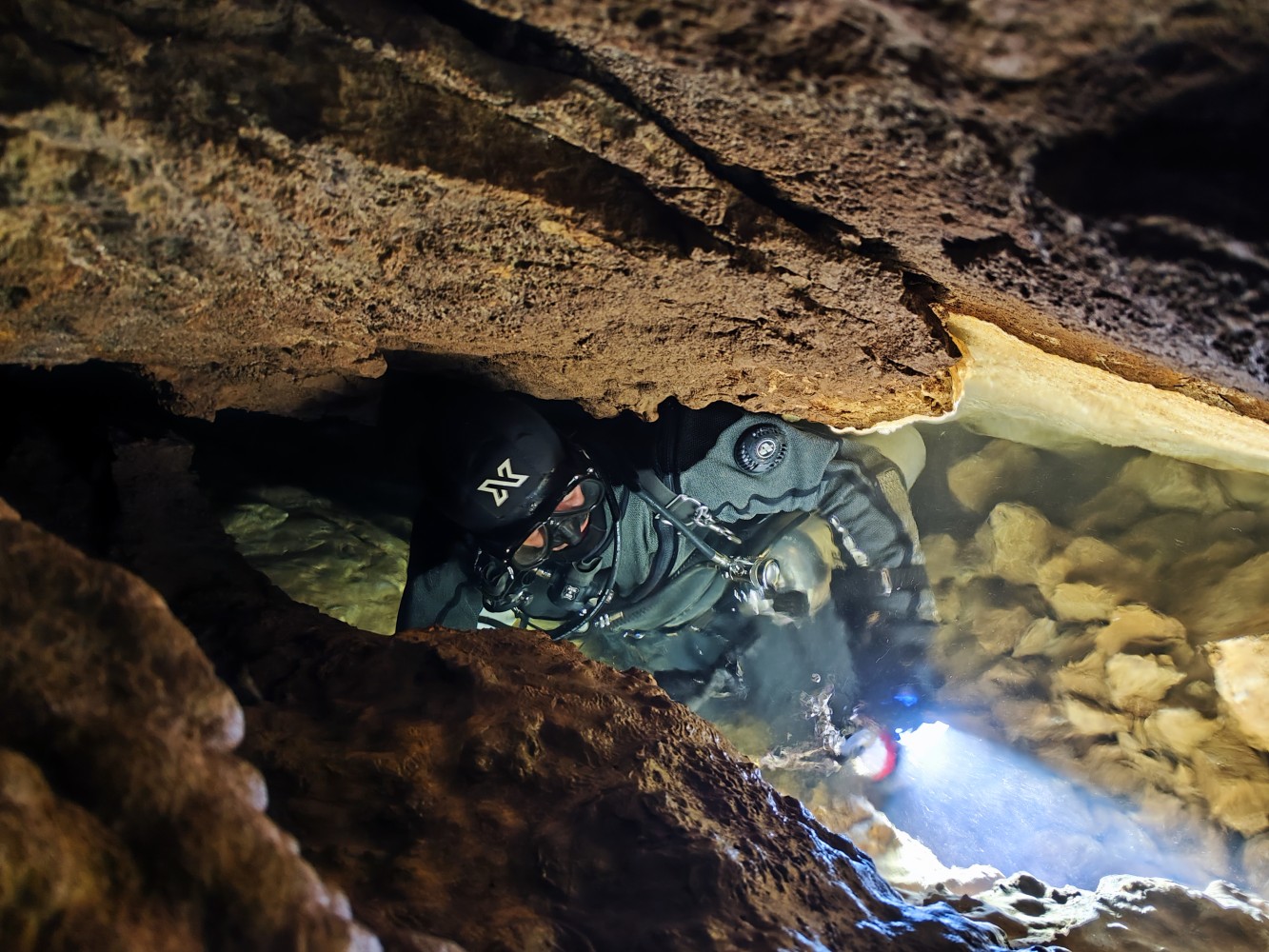
Diving in Jablan Cave (named by our team) near Nikšić, as part of BIOTA’s research on the cave fauna of the Nikšić polje (Montenegro).

For example, diving in Jablanova Cave near Nikšić, Montenegro, was conducted as part of BIOTA’s research into cave fauna in the Nikšić field. Diving in such environments requires knowledge of speleology, as siphons (water-filled passages) are typically found at the ends of channels and cave systems, requiring caving techniques to access. Croatia is rich in stunning, deep springs and numerous caves, many of which remain unexplored. Cave siphon diving is often the next step after cavers encounter a water barrier (a siphon). Diving in deeper cave siphons is considered the most complex form of speleodiving, requiring a large, well-coordinated team to transport equipment, while divers themselves must be experienced speleologists able to navigate deep passages using ropes.

Population Estimation

Monitoring of the olm population is conducted using line transect methodology during cave dives. A researcher, who is also a cave diver, follows a pre-defined transect line (a line set up in advance, also serving as a safety line for emergencies) of a known length. The diver records all individuals seen in front, to the left, and to the right, noting their distance from the transect line. This distance is measured as a perpendicular line from the individual to the transect line, and the measurements are recorded with an accuracy of 0.1 meters in the diver’s logbook.

It is critical for the divers to swim slowly along the transect line to observe as many individuals as possible. However, they must not move too slowly, as this could disturb the monitoring process (animals ahead of the diver may flee before being recorded, and previously recorded individuals could be counted twice). If an olm is directly on the transect line, its distance is recorded as 0 meters from the line.
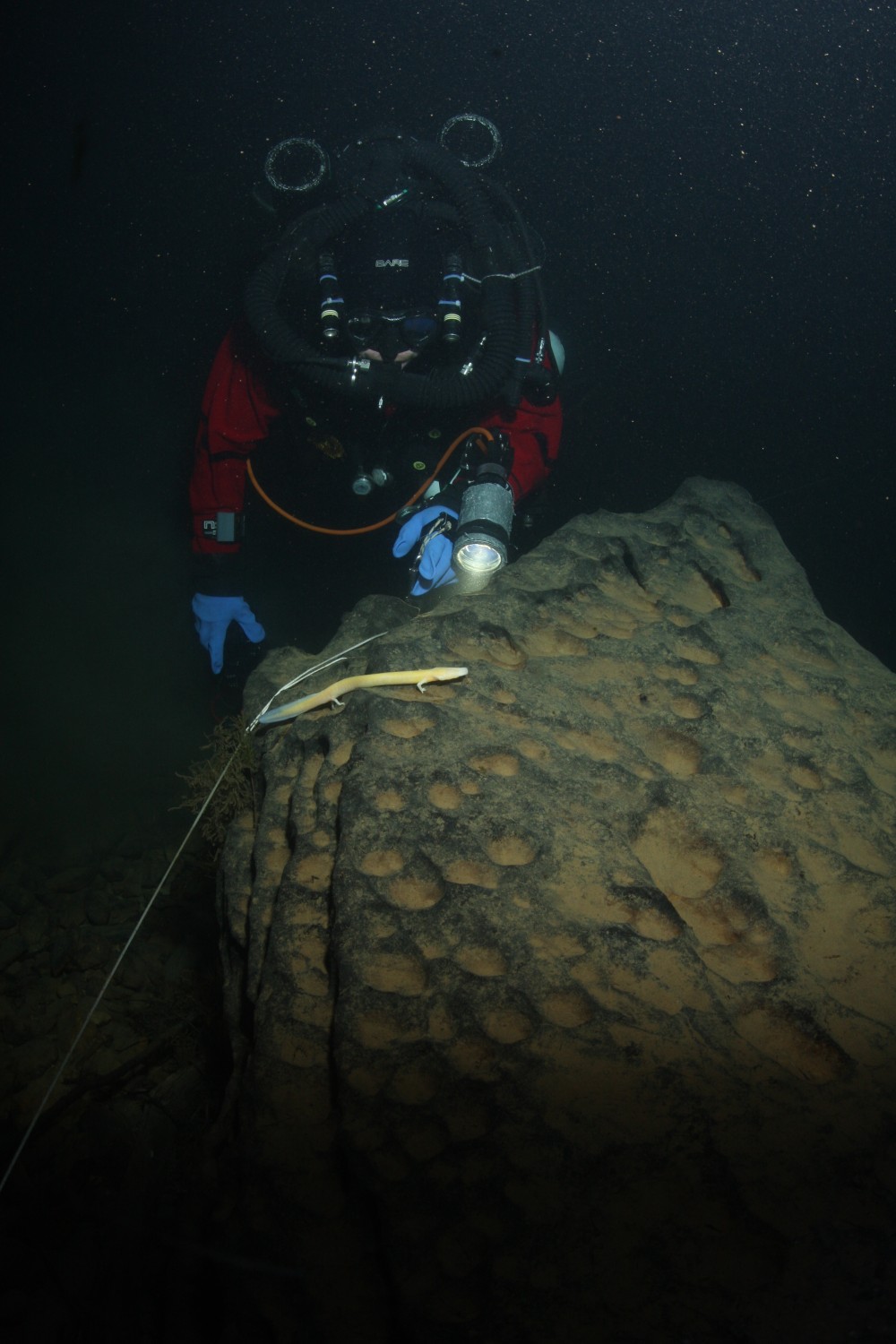
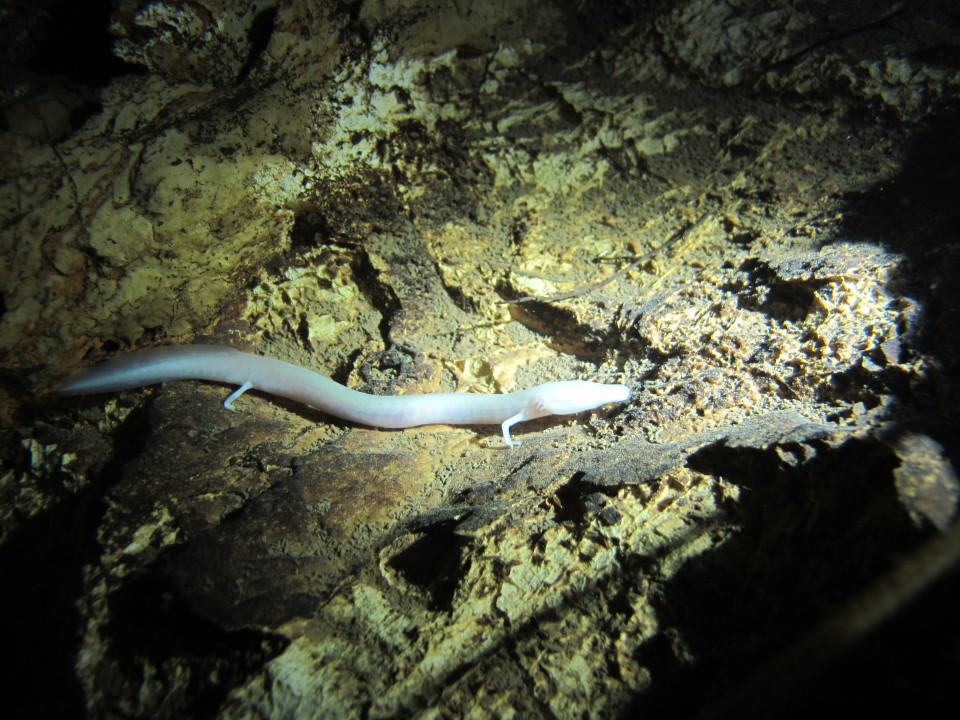
A specimen of the olm (Proteus anguinus) directly on the transect line is counted as being at a distance of 0m from the line.

For safety and protocol, two researchers are involved in the monitoring process. The first researcher counts the individuals, while the second monitors environmental parameters and ensures safety. It is important to note that the goal is not necessarily to count as many individuals as possible but to accurately record their perpendicular distance from the transect line. Monitoring is carried out when conditions are ideal, meaning during periods of average or low water flow and when visibility is optimal. Monitoring is not recommended after periods of rain or during high water levels. Ideally, the same two observers should conduct the monitoring year after year. If this is not possible, consistency should at least be maintained throughout a single year’s cycle.
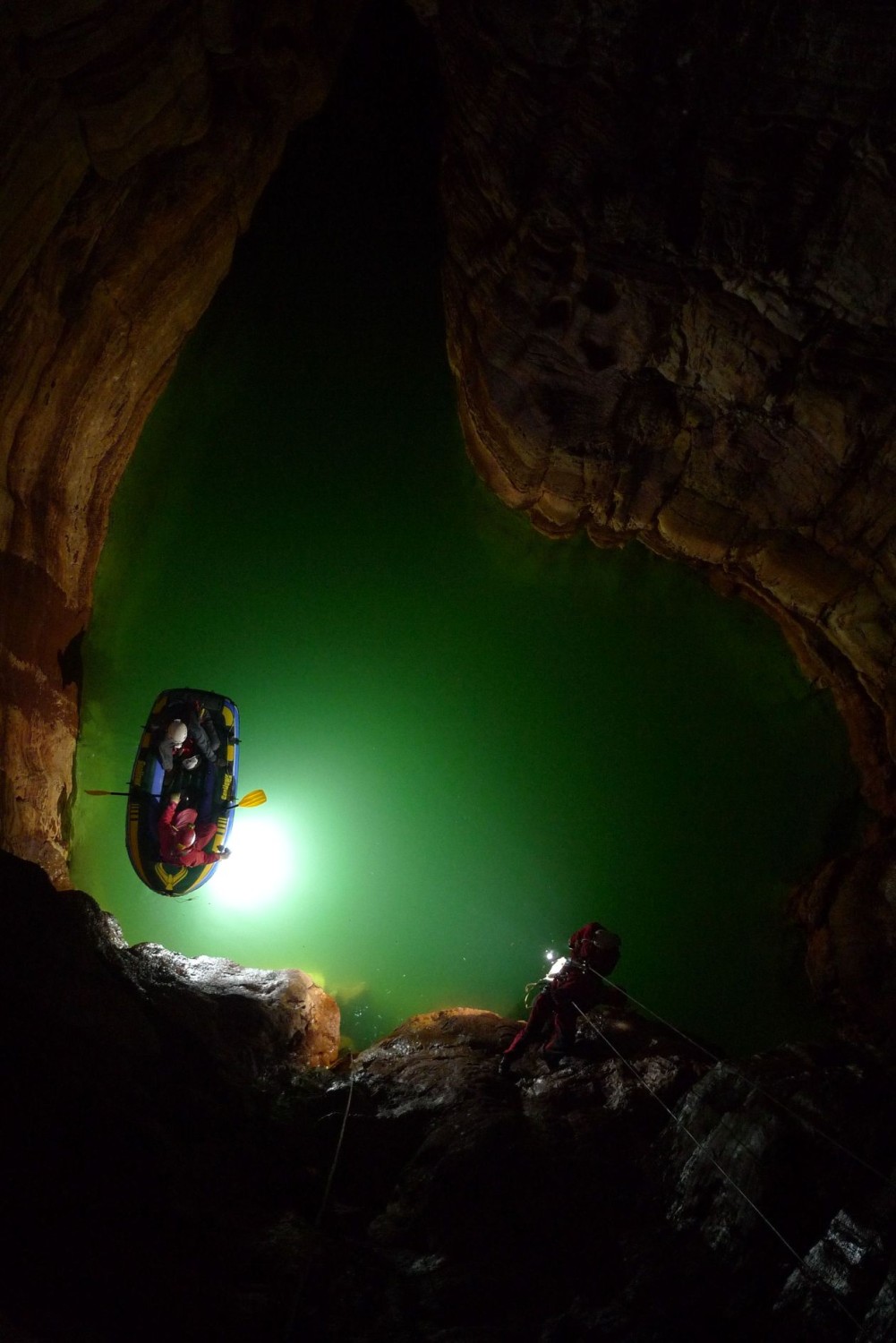
Monitoring the state of the olm in a cave in Istria. Entry into the water is directly from a rope, and the diver must descend straight into the water, carrying diving equipment as well as caving gear (for climbing/descending) over it.

Analysis and Population Size Estimation

The data collected is analyzed to produce an absolute population estimate, calculating the number of olms per square meter and hectare of habitat. These values are then scaled up to the total size of the location (multiplying the number per square meter by the known area of the cave system). The final result is an estimate of the relative population size of mature, sexually mature individuals for the entire location (the known part of the system). This method is sufficient for long-term population trend monitoring.
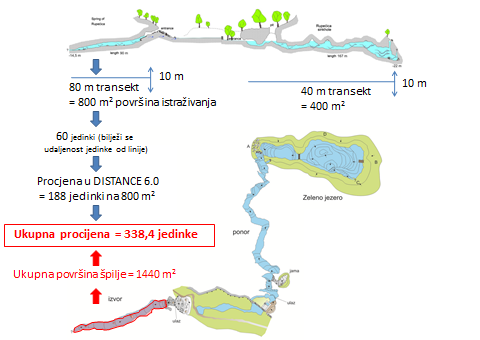
A schematic representation of the methodology used to estimate the absolute population size of the olm (Proteus anguinus) shows the process.

The data is analyzed using the linear transect methodology and the DISTANCE software (version 8.0). This approach is based on data showing how many individuals were observed at a given perpendicular distance and how many went undetected. The distribution and number of detected individuals are used to estimate the number of undetected individuals. By adding these two values, an overall absolute population size can be determined. The DISTANCE software can be downloaded from their website.

For the development of similar species population estimation procedures tailored to your needs, feel free to contact us.

Zamenis situla

Zamenis situla lives a life that is almost perfectly optimized to avoid detection. It is active during short and often unpredictable windows. It prefers complex, three-dimensional microhabitats like stone walls, rocky crevices, and dense vegetation where visibility is minimal. It does not bask conspicuously. It does not flee dramatically. More often than not, it freezes, disappears, or never emerges in the first place. From an evolutionary perspective, this makes perfect sense. From a monitoring perspective, it is a nightmare.

And this is where a fundamental mismatch appears between how conservation monitoring is designed and how some species actually live.

Most monitoring frameworks, especially those linked to Natura 2000 obligations, are built on a quiet assumption: that with sufficient effort, you will eventually detect the species. That presence can be confirmed repeatedly. That population size can be estimated. That trends can be calculated. On paper, this sounds reasonable. In reality, for species like Zamenis situla, it often turns into a multi-year exercise in disciplined failure.

We tried everything we were supposed to try. Capture–mark–recapture, the gold standard of population estimation, was implemented carefully and consistently. After three years, recaptures were still too rare to produce any meaningful population estimates. The statistics simply refused to cooperate, not because the method was flawed, but because the species never appeared often enough to close the loops that the models require.

We walked line transects (for Distance methodology), again and again, knowing full well that the probability of encountering such a cryptic snake on an imaginary line through the landscape was low, but hoping that repetition would eventually tip the balance. It didn’t. Common, active snake species showed up. Zamenis situla almost never did. The transects were clean, the data sheets were tidy, and the result was silence.

We set up permanent plots and applied the Occupancy models, accepting that absolute counts might be unrealistic and that presence–absence could be a more honest goal. But even here, detection probability became the limiting factor. Entire predefined squares remained empty year after year, not because the species was absent, but because its lifestyle simply didn’t intersect with our sampling windows often enough to leave a detectable signal.

At the end we also tried to add environmental DNA detecton to the occupancy model to increase the number of records, but eben this yielded a very low detectability, as it seems that besids being elusive, leopard snake is also rare (low number/area) compared to other species and also quite unselective in habitat type (present in low number in variety of habitats). 

Ironically, the most consistent records we obtained came from places no one wants to rely on: roads. Dead-on-road individuals. Road transects. Asphalt cutting through stone-rich landscapes. It’s uncomfortable to admit, but roads are often the places where elusive animals briefly become visible, precisely because movement — not habitat — is what exposes them. These records don’t represent healthy systems, but they do represent reality. Ignoring them would have meant ignoring the majority of what the species was willing to show us.

At some point, we had to stop asking a question that clearly wasn’t working. “How many individuals are there?” sounds like the right question, but for species like this, it may simply be the wrong one. So we shifted our thinking. Instead of chasing absolute population size, we focused on something more modest, but far more robust: relative abundance based on effort – CPUE (Catch Per Unit Effort) methodology.

How many individuals do we detect per person-hour of fieldwork? How many per kilometer surveyed? These numbers don’t pretend to tell us how many snakes exist in total. What they do tell us is whether our interaction with the species is changing over time, under comparable conditions and comparable effort. They give us a baseline. A reference point. A way to compare years, sites, and methods without forcing the data to say something it cannot support.

Once we accepted this shift, something important happened. Monitoring stopped feeling like failure. The data, sparse as it was, started to make sense within its own limits. We could finally talk about trends, not in absolute terms, but in relative ones. And for elusive species, relative trends are often the only trends that exist.

Another realization followed naturally. You cannot interpret Zamenis situla in isolation. Its signals are too faint. Its numbers too low. So we began looking at other snake species within the same system, especially those that are more detectable and respond more visibly to environmental change. Their relative abundance became a contextual reference — a way to understand whether changes observed in Zamenis situla reflect species-specific dynamics or broader ecological shifts affecting the entire snake community.

CPUE_snake_comparison_Telascica

What the numbers actually show

When survey effort is standardized using CPUE (detections per person-hour), a clear pattern emerges. Our example is calculated for Telašćica Nature Park (Croatia): some snake species, like Malpolon insignitus, are detected frequently and predictably, while others appear far less often despite the same level of field effort. Zamenis situla falls into this second group with just 0.105 detections per person-hour. Its detection rate is low, but importantly, it is not an outlier — it aligns closely with other elusive snake species such as Elaphe quatuorlineata. In practical terms, this means the species is present, but encounters are rare by nature, not necessarily because populations are collapsing. The value of CPUE lies precisely here: it allows us to compare species fairly under equal effort and to track changes over time, even when absolute population counts are impossible.

Slowly, a clearer picture emerged. Not a precise one. Not a comfortable one. But an honest one.

The real challenge of monitoring rare and elusive species is not technical. It’s philosophical. It requires accepting uncertainty, resisting the urge to over-quantify, and designing monitoring systems that respect biological reality rather than forcing it into predefined statistical boxes. Some species will never give us neat datasets. Some will always exist at the edge of detectability. That does not make them unsuitable for monitoring — it makes them unsuitable for rigid expectations.

In the end, working with species like Zamenis situla teaches you humility. It reminds you that absence of data is not data of absence, that rarity is not always decline, and that conservation is as much about listening carefully as it is about counting. Some species don’t want to be measured. They don’t announce themselves. They don’t make things easy.

And what is next for us? We plan to further test the CPUE methodology and fine-tune it at our most effort-intensive site, the BIOTA research center in Krka National Park, where snake research averages about 4,500 person-hours per year. It’s the only site where even Zamenis situla recapture rates reach around 10%, allowing us to calculate survival, density, detectability, and absolute population size for comparison with CPUE relative estimates.

Zamenis situla

Practical guide: how we actually calculated CPUE (Catch Per Unit Effort)

1. Defining the problem correctly

Before any method was selected, the problem was reframed.

We explicitly accepted that:

  • absolute population size estimation was unlikely to be achievable

  • detection probability was extremely low and variable

  • zero detections could not be interpreted as absence

  • standard outputs (N, density, occupancy probability per grid) were unrealistic goals

The primary objective therefore became:

To establish a repeatable, effort-standardized system that allows comparison through time and space, even when detections are rare.

This single decision guided everything that followed.

2. Field effort standardization (the non-negotiable foundation)

Relative abundance metrics are meaningless without strict effort control.

For every field activity, we recorded:

  • number of observers

  • active survey time (in hours)

  • distance covered (in kilometers)

  • survey type (active search, road transect, incidental)

  • weather conditions and time of day

Only surveys that met predefined comparability criteria were included in calculations (similar season, similar time window, similar survey intent).

This allowed us to later express detections per unit of effort, not as raw counts.

3. Survey types used (and how they were treated analytically)

We did not exclude methods that performed poorly in isolation.
Instead, we treated each method as a filter with its own bias, then decided which outputs were usable.

a) Active visual search (time-based)

This included:

  • slow searches of stone walls, rocky slopes, and vegetation

  • targeted microhabitat inspection

  • surveys conducted during biologically plausible activity windows

Output used:

  • detections per person-hour

Even when detections were rare, time-based standardization allowed comparison between years.

b) Line transects (distance-based)

Transects were walked repeatedly in the same areas.

Outcome:

  • detection probability for Zamenis situla was near zero

Decision:

  • transects were not abandoned

  • but their outputs were not used as standalone indicators for the target species

  • they remained useful for other snake species, which later became reference indicators

c) Permanent plots and occupancy framework

Permanent plots were surveyed repeatedly.

Outcome:

  • insufficient detections to parameterize occupancy models for the target species

Decision:

  • occupancy was rejected as a primary metric for Zamenis situla

  • plots were retained for long-term presence documentation and ancillary species data

This is an important point:
Rejecting a method analytically is not the same as abandoning it operationally.

d) Road transects (distance-based, movement-driven)

Road surveys were conducted systematically:

  • same road sections

  • repeated over years

  • recorded both live and dead individuals

Key insight:
Roads intersect movement, not habitat. For elusive species, this matters more than idealized sampling design.

Output used:

  • detections per kilometer

This became one of the most robust indicators for the target species.

4. The core metrics we calculated

We ultimately focused on two primary metrics, both intentionally simple:

Metric 1: Detections per person-hour

RAtime=Number of detected individualsTotal observer hoursRA_{time} = \frac{\text{Number of detected individuals}}{\text{Total observer hours}}


Metric 2: Detections per kilometer

RAdistance=Number of detected individualsTotal kilometers surveyedRA_{distance} = \frac{\text{Number of detected individuals}}{\text{Total kilometers surveyed}}


These metrics were calculated:

  • per year

  • per survey type

  • using only comparable effort blocks

They were never mixed or pooled without clear justification.

5. Why we explicitly avoided “population estimates”

At no point did we extrapolate these metrics to population size.

We did not:

  • convert detections to density

  • scale results to total habitat area

  • infer absolute abundance

Why?

Because doing so would create false precision.
Relative abundance was treated exactly as that — a relative index, not a hidden proxy for population size.

6. Establishing a baseline (the most important output)

The first years of data were treated as baseline calibration, not evaluation.

Instead of asking:

“Is the population increasing or decreasing?”

We asked:

“What does ‘normal detectability’ look like for this species under standardized effort?”

This baseline now functions as:

  • a reference point for future monitoring

  • a conservation target framework

  • a threshold system for detecting change

7. Adding a third dimension: other snake species as context

Because Zamenis situla produces weak signals on its own, we incorporated other snake species into the analytical framework.

For each year, we calculated the same relative metrics for:

  • common, more detectable snakes

  • species with overlapping habitat use

These species were not treated as controls, but as contextual indicators.

Interpretation followed a simple logic:

  • parallel declines → system-level signal

  • divergence → species-specific dynamics

  • stability in common species + change in target species → real biological signal

This step dramatically improved interpretability.

8. What this framework can and cannot do

It can:

  • detect long-term trends

  • provide objective, repeatable indicators

  • support conservation objectives

  • function under extreme detectability constraints

It cannot:

  • estimate population size

  • replace demographic studies where feasible

  • eliminate uncertainty

And that is precisely why it works.

9. Why this approach is transferable

This framework is applicable to:

  • cryptic reptiles

  • nocturnal mammals

  • rare amphibians

  • low-density invertebrates

  • any Natura 2000 species with structurally low detectability

The key is not the species.
The key is the willingness to design monitoring around reality instead of expectation.

Final note for practitioners

If you take only one thing from this guide, let it be this:

When detection is the limiting factor, trend detection beats population estimation.

Once you accept that, monitoring rare and elusive species stops being an exercise in frustration and starts becoming a disciplined, honest form of ecological listening.

And sometimes, that is exactly what conservation needs. 

Written by Dusan Jelic

Related Posts

The Elusiveness Fallacy – how to monitor species that prefer to stay hidden

The Elusiveness Fallacy – how to monitor species that prefer to stay hidden

What do you do when a protected species is present, but almost never seen? Some animals aren’t rare because they’re disappearing — they’re rare because that’s how they live. This article explores why monitoring elusive species like the spotted whip snake breaks traditional conservation methods, and how we learned to listen to faint ecological signals instead of chasing impossible numbers.

read more
Tagging Hope: A Decade of Protecting Croatia’s Last Telestes souffia in the Bregana River

Tagging Hope: A Decade of Protecting Croatia’s Last Telestes souffia in the Bregana River

In 2025, our team completed the latest chapter of a decade-long effort to protect Telestes souffia, tagging 30 adult individuals in the Bregana River using BIOMARK PIT technology. Each fish was gently anesthetised, measured, weighed, and fitted with an 8 mm microchip to enable long-term tracking of survival and movement in its last Croatian habitat. The work builds on earlier studies, including the 2017 research that documented a small and declining population, underscoring the urgency of continued monitoring. With new data now collected, updated 2025 population estimates are on the way — and hope for the species continues to flow with the Bregana.

read more

0 Comments